
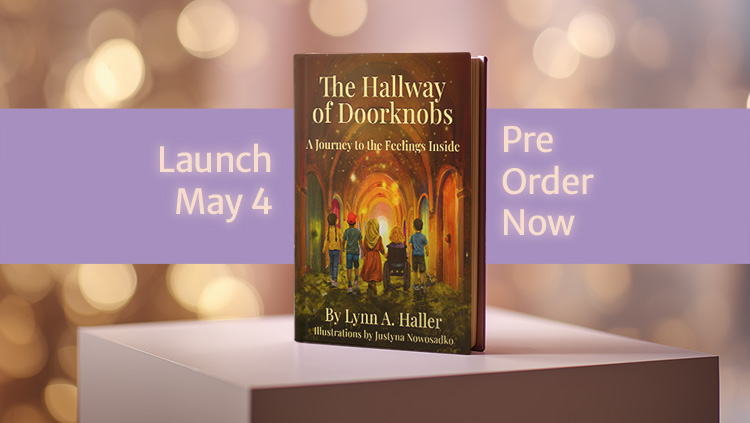

- Introducing The Hallway of Doorknobs - April 21, 2026
- What Editors Mean When They Say “Conflict Feels Manufactured” - December 28, 2025
- Small Presses Should Champion Seasoned Romance - November 16, 2025
When a Child Can’t Tell You What’s Wrong: A Book That Opens the Door
You know something’s happening inside them. Maybe your child flinches at loud voices, or goes quiet in ways that feel too heavy for their age. Maybe they perform, all sparkle and deflection, or maybe they’ve stopped asking for help entirely. You want to reach them. But “tell me how you feel” lands like a question they don’t know how to answer, and treating the behavior as something to fix only pushes them further away.
The Hallway of Doorknobs: A Journey to the Feelings Inside was written for exactly this moment.
What is The Hallway of Doorknobs?
Five children discover a hallway they’ve never noticed before. The floor is soft like moss, the walls shimmer like stars, and each door has a completely different, magical doorknob. Behind those doors, they meet characters that represent the protective parts every person carries inside: a prickly cactus whose spines soften when approached with care. A fiery lava figure that cools when met with empathy. A dazzling disco ball that spins and performs to keep vulnerability at a distance. A quiet figure wrapped up tight who has simply shut down.
The children don’t fix these parts. They don’t fight them or banish them. They meet them with curiosity and kindness, and the parts soften. By the end, the children recognize the same protectors inside themselves, and they leave with the question the book hopes every reader will carry: Who do you talk to about your parts?
Quick Answers
Is this a book about emotions?
Not exactly. The characters behind the doors are not emotions; they are parts, protective responses that developed to help a child cope. A child who lashes out has a protector that learned to fight because fighting once kept them safe. The book helps children (and the adults reading with them) see that difference.
What age is it for?
The book is written for children ages 6 to 10, but its real audience is wider. Parents, therapists, educators, and behavior support professionals are already using it as a conversation tool and a session resource.
What framework is it based on?
The Hallway of Doorknobs is grounded in Internal Family Systems (IFS), a therapeutic model developed by Dr. Richard Schwartz that understands the mind as made up of different parts. Rather than treating difficult behaviors as flaws to fix, IFS sees them as protectors that need to be understood.
Why This Book Matters
Most children’s books about emotional literacy ask kids to name their feelings. That’s a reasonable starting point, but it doesn’t go far enough. A child who is shutting down isn’t simply “sad.” A child who is performing isn’t simply “happy.” What’s happening is more layered than a feelings wheel can capture, and children sense that gap even when they can’t articulate it.
What The Hallway of Doorknobs does differently is make the invisible visible. You don’t explain “defensiveness” to a seven-year-old. You show them a cactus being prickly to stay safe, and they say, “Oh. I do that.” Now you have a shared language. Now you have a door into a conversation that wasn’t possible five minutes ago.
That’s the bridge this book builds: not between a child and a diagnosis, but between a child and the adult who wants to understand what’s happening inside them.
About the Author
Lynn A. Haller, MSW, LCSW is a trauma-informed psychotherapist and educator with over 25 years of experience supporting individuals navigating complex emotional and behavioral challenges. Her career began in the juvenile justice system, providing counseling and crisis intervention to incarcerated youth and their families. That early work included a creative newsletter developed with incarcerated teens, a project that taught young people to use writing and photography to find their voice.
That same belief, that story and art can empower people to see themselves differently, runs through every page of The Hallway of Doorknobs. Read the story behind the writing of the book on Lynn’s site.
Coming May 4, 2026
The Hallway of Doorknobs: A Journey to the Feelings Inside is available in hardcover ($27.99) and paperback ($16.99). Preorder your copy now on Lingua Ink.
If you work with children and want to bring IFS into your classroom, practice, or home in a way that a six-year-old can hold in their hands, this is the book written for you.