

- Behind the name: Sara - October 7, 2026
- Behind the name: Manuel - October 5, 2026
- Behind the name: Amira - October 1, 2026
How a 7-Year-Old Girl and a Living Room Floor Taught Me About Play
“You Know Today Is Draw a Bird Day”
I was finishing up my monthly supervision when my supervisor looked at me and said, “You know today is Draw a Bird Day.”
I stared at him. He had a dry sense of humor, so I wasn’t sure if he was serious. But something about it stuck with me, and when I looked it up later, sure enough, it was real.
And the story behind it stopped me.
Dorie
In 1943, a 7-year-old girl named Dorie Cooper was living in England when her mother took her to visit her uncle in the hospital. He had been badly wounded in the war and lost his right leg to a land mine. Dorie looked at him and said:
“Draw a bird for me, please.”
He was in pain, but he agreed. He looked out the window, saw a robin, and drew it for her.
Dorie laughed out loud and told him he was not a very good artist, but that she would hang the picture in her room anyway. His mood lightened. The other wounded soldiers nearby watched the whole thing.
What started as one little girl’s request turned into something bigger. Every time Dorie visited, the soldiers held drawing contests. Within months, the ward’s walls were covered with bird pictures.
But the story doesn’t stay carefree. Three years later, Dorie was hit by a car and killed. She was ten years old. At her funeral, her coffin was filled with bird drawings from soldiers, nurses, and doctors. People whose spirits she had lifted with one simple, playful request.
From then on, they remembered her by drawing birds on her birthday.
The Living Room Floor
 That night, I told my daughter the story. She was about nine at the time. She didn’t care much about the story, honestly. But she loved to draw.
The story inspired me. I let go of all my usual tasks, the dishes and the laundry. I didn’t have all of the IFS language then, but I would have asked my responsible part to allow the to-do list to wait a bit. I decided to be creative with my daughter. So we laid side by side on the living room carpet, markers spread out between us, cartoons on in the background, and we started drawing birds.
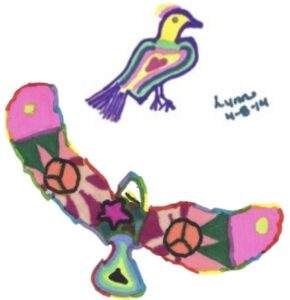
Mine was small. Colorful but contained. A little bird with a heart on its chest, signed and dated in the corner.
Hers was huge. Wings spread wide, filled with peace signs and stars and every color she could get her hands on. Bold and unapologetic, the way nine-year-olds are when there are no instructions, grades, or time limits.
When we finished, we looked at each other’s birds and laughed at how different they were. We talked about doing it every year.
We never did. She moved on to the next thing, because she was nine. I have no idea if she even remembers Draw a Bird Day. But I kept the drawings.
What Creativity Actually Looks Like
The important thing that night wasn’t our talent or technique. It was just being creative and spending time together. That’s what I remember about it today and why I kept our drawings. No one was grading our birds.
In Internal Family Systems (IFS), Creativity is one of the 8 Cs of Self. It’s something we’re all born with, but sometimes our critical, perfectionist, or responsible parts step up. They mean well. They’re trying to protect us from embarrassment or failure, or reminding us there’s laundry to fold. But when we give them some understanding, they can soften. Think about the way children create. Their curiosity is pure, unfiltered. When we can access that same openness, our creativity can feel like lightness and joy.
In therapy, Creativity can open doors that logic can’t always reach. When we invite clients to draw a part or write to it, something shifts. Even simply imagining what a part looks like can open something up. Parts that have been stuck can express what they carry in ways that words alone don’t capture. The client might find more compassion for that part or understand it better.
Dorie knew this without any framework or language for it. She didn’t ask her uncle to make something beautiful. She asked him to draw a bird. The request itself was the gift. It gave a wounded man permission to play, and that permission spread through an entire hospital ward.
Creativity doesn’t require a canvas or a stage. Sometimes it just needs a carpet, some markers, and someone willing to draw a bird that’s not going to end up in the Museum of Modern Art.
A Reflection for Your Journey
Creativity is a quality we all have access to. It lives in the small choices to express, play, and connect.
- When was the last time you created something purely for joy, with no concern about whether it was good?
- What critical or perfectionist parts might be keeping your creative expression quiet? What are they trying to protect you from?
- Is there someone in your life who gives you permission to play the way Dorie gave those soldiers permission?
An Invitation to Create
In honor of Dorie and the healing power of a simple request:
Draw a bird today. Let it be imperfect or playful. Entirely your own. Share it with someone, or keep it as a gift to yourself. Notice what it feels like to create freely.
And if you do draw one, I’d love to see it.
Birds have a way of showing up in my life in interesting ways. But those are stories for another time.
This post is part of my monthly series exploring the 8 Cs of Internal Family Systems, a framework that shapes how I teach, write, and support healing. The 8 Cs are qualities described by Dr. Richard Schwartz, founder of the Internal Family Systems (IFS) model.